

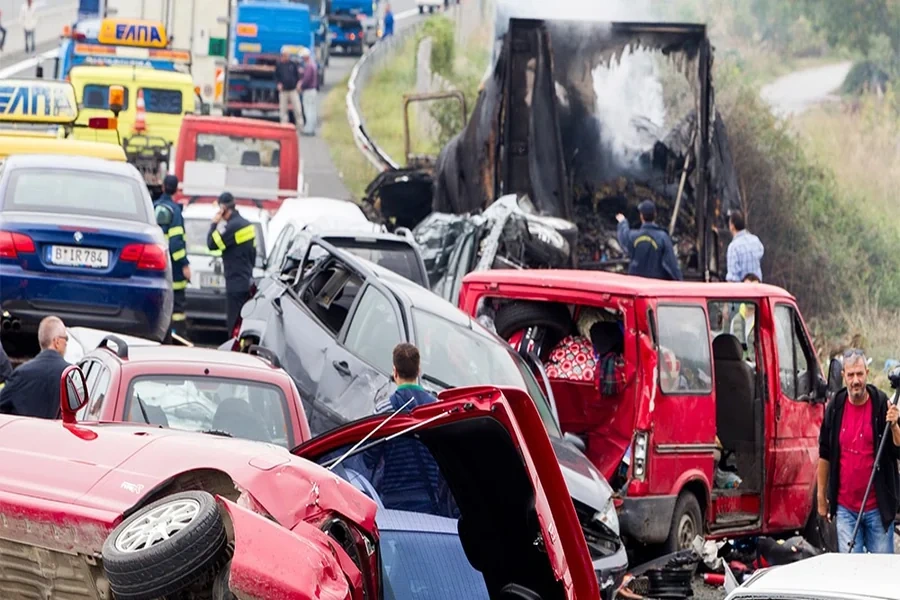
Multi-vehicle pileups are among the most chaotic and destructive types of accidents that occur on Pennsylvania’s roads. These chain-reaction crashes, which can involve anywhere from three to dozens of vehicles, typically happen on high-speed highways during adverse weather conditions, in heavy traffic, or when a sudden obstruction appears in the roadway.
From a legal standpoint, multi-car pileups present unique challenges. With multiple drivers, multiple points of impact, and often conflicting accounts of what happened, determining who is at fault and how to allocate responsibility requires careful investigation and a thorough understanding of Pennsylvania’s comparative negligence system.
How Multi-Vehicle Pileups Happen
Multi-car pileups are rarely caused by a single act of negligence. Instead, they typically involve a sequence of events where an initial collision or hazard triggers a chain reaction among vehicles that are following too closely or driving too fast for conditions.
• Sudden stops in heavy traffic. A lead vehicle stops suddenly, and following vehicles are unable to stop in time, creating a cascade of rear-end collisions.
• Reduced visibility. Fog, heavy rain, snow, and blowing dust can reduce visibility to near zero on highways, causing drivers to collide with stopped or slow-moving vehicles they cannot see.
• Ice and snow. Slippery road surfaces extend stopping distances and reduce vehicle control, making chain-reaction crashes more likely.
• Debris or objects in the roadway. A tire blowout, fallen cargo, or an animal on the highway can trigger sudden braking and lane changes that lead to multi-vehicle crashes.
How Fault Is Allocated in Multi-Vehicle Crashes
Pennsylvania’s modified comparative negligence system under 42 Pa.C.S. § 7102 requires the jury to assign a specific percentage of fault to each party involved in the accident. In a multi-car pileup, this means that fault may be distributed among three, five, ten, or more drivers based on their individual conduct. Understanding how fault works in Pennsylvania accident cases is particularly important in these complex scenarios.
The analysis considers each driver’s speed relative to conditions, following distance, attentiveness, reaction time, and compliance with traffic laws. A driver who was maintaining a safe following distance and driving at an appropriate speed for the conditions may bear little or no fault, while a driver who was tailgating at excessive speed may bear a disproportionate share.
The Challenge of Conflicting Evidence
In a two-vehicle accident, there are typically two versions of events. In a multi-vehicle pileup, there may be a dozen or more conflicting accounts, and the physical evidence from the scene is often difficult to interpret because the vehicles have been struck multiple times from multiple directions.
Accident reconstruction experts play an essential role in these cases, using vehicle damage analysis, debris patterns, electronic data recorder information, and witness statements to piece together the sequence of collisions and determine each driver’s contribution to the crash.
Insurance Complications in Pileup Cases
Multi-vehicle pileups create complex insurance situations. Multiple at-fault drivers means multiple liability policies, and coordinating claims across several insurers can be time-consuming and contentious. Each insurer will attempt to minimize its client’s share of fault and shift responsibility to other drivers.
Additionally, the total damages in a pileup may exceed the combined policy limits of all at-fault drivers. When this happens, the injured parties may need to rely on their own UM and UIM coverage to make up the shortfall. If multiple drivers carry stacked UM/UIM coverage, the total available compensation can be significantly higher.
Injuries in Multi-Vehicle Pileups
The injuries sustained in multi-car pileups tend to be severe because vehicles may be struck multiple times from different directions. Occupants who survive the initial impact may be injured again by subsequent collisions before they can exit the vehicle.
Common injuries include traumatic brain injuries from repeated impacts, spinal cord injuries from compression and lateral forces, crush injuries when vehicles are compressed between other vehicles, burns when fuel systems are compromised and fires ignite, and psychological trauma from being trapped in a vehicle during a chaotic, ongoing collision event.
Steps to Take After a Multi-Vehicle Pileup
If you are involved in a multi-car pileup in Pennsylvania, your first priority is personal safety. If you are able to exit your vehicle safely, move away from the roadway to avoid being struck by additional vehicles. Call 911 immediately and request medical assistance for yourself and others.
Document as much as you safely can, including photographs of vehicle positions, damage, road conditions, and weather. Exchange information with other drivers and collect witness contact details. Obtain the police report, which will document the officer’s observations and initial fault assessments.
Because liability in multi-vehicle pileups is complex and involves multiple parties and insurers, preserving evidence and beginning the investigation early is critical. The sequence of collisions, each driver’s speed and following distance, and the conditions at the time of the crash all need to be established before evidence is lost or memories fade.
 Ali
Ali